
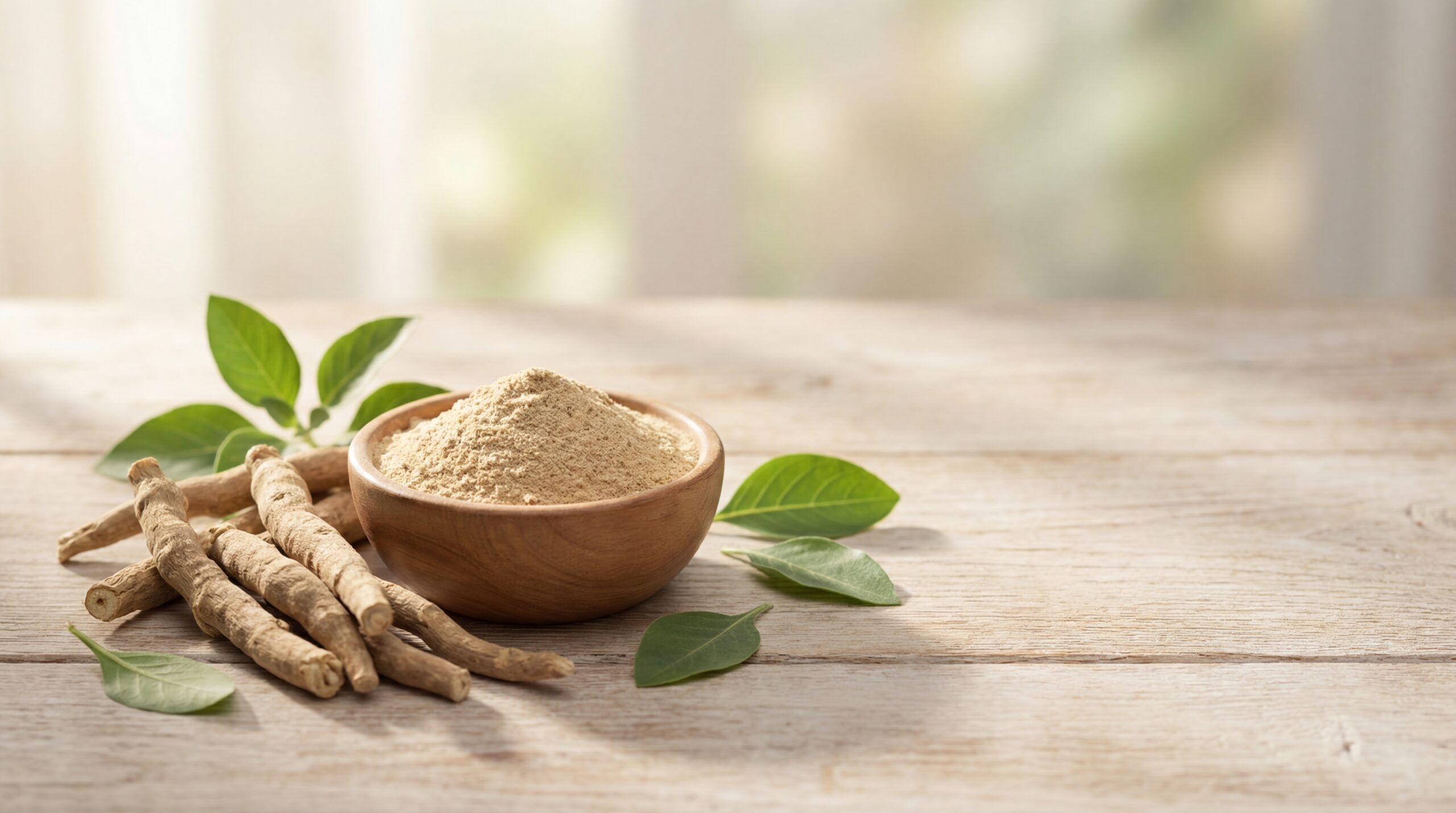
Ashwagandha is a powerful adaptogen that helps you handle stress better, improve sleep, and support hormonal balance, including testosterone and thyroid function.
What is ashwagandha?
Ashwagandha (Withania somnifera) is a herb from traditional Ayurvedic medicine that has been used for thousands of years to increase the body’s resilience to stress. In modern terms, it is classified as an adaptogen: a substance that helps you adapt to physical and mental stress without completely draining your system.
What makes ashwagandha unique is that it acts as a “cortisol modulator.” If your cortisol is too high (chronic stress, wired feeling, poor sleep), it can help bring it down; if your cortisol is too low (burnout-like fatigue, afternoon crashes), it can help normalize it.
Benefit 1: less stress and a calmer mind
For busy students and entrepreneurs, chronic stress has almost become the default. Ashwagandha can help bring that stress load back to a healthier baseline.
- It supports a healthier daily cortisol curve, which means fewer highs and lows throughout the day.
- Many users report less anxiety, reduced nervousness, and better stress tolerance.
- It also acts on neurotransmitters like GABA, which are involved in calmness and relaxation.
In practice, this often shows up as feeling less easily overwhelmed, less overthinking, and having more emotional buffer when things go wrong.
Benefit 2: deeper sleep and better recovery
Poor sleep is devastating for your focus, hormones, and muscle recovery. Because ashwagandha helps normalize stress hormones, it can also support sleep quality.
- Research suggests that ashwagandha can improve sleep quality and reduce stress-related insomnia.
- With lower and more stable cortisol levels, it becomes easier to enter deep (delta) sleep, the phase where real physical recovery happens.
For you, that means waking up more refreshed, relying less on coffee to function, and having more energy to perform – both in the gym and behind your laptop.
Benefit 3: testosterone, muscle growth and performance
If you train in the gym or simply want more physical power, ashwagandha becomes especially interesting.
- Studies show that ashwagandha can increase testosterone, particularly in men with lower levels or high stress.
- It may improve muscle strength and endurance and speed up recovery after resistance training.
- Because cortisol and testosterone sit on opposite sides of the hormonal “scale,” normalizing cortisol indirectly supports a more anabolic environment.
In real terms: more progress in the gym, better recovery after hard sessions, and more physical drive throughout the day.
Benefit 4: thyroid, metabolism and energy
Ashwagandha also affects thyroid function and metabolism, which are crucial for sustained energy.
- There is evidence that ashwagandha can support a sluggish thyroid (hypothyroidism) and stimulate the production of T3 and T4.
- Chronically elevated cortisol is linked to insulin resistance, belly fat, and energy crashes; by normalizing cortisol, you indirectly support blood sugar control and fat metabolism.
For someone who sits a lot, eats irregularly, and trains in between, this can be the missing link to more stable energy and fewer “after lunch crashes.”
Benefit 5: brain, focus and mental clarity
Beyond stress and hormones, ashwagandha also offers benefits for your brain.
- It can help protect the brain from stress through antioxidant and anti-inflammatory effects.
- Users often report less brain fog, better concentration, and greater mental resilience.
This is exactly what you need if you want to study in the evening after work or school, build your business, or create content.
How to use ashwagandha (dosage and timing)
Exact dosage depends on the product you use, but these are commonly used ranges in studies and practice.
Capsules / tablets
- Common range: 250–500 mg ashwagandha extract, 1–2 times per day.
- Many products use standardized extracts (such as KSM-66 or Sensoril); always follow the dosage on the label.
Liquid form (tincture)
- For a 1:5 tincture, 2–4 ml up to three times per day is often used.
Best time to take it
- Many people take ashwagandha in the evening with or after a meal to enhance the calming effect and support sleep.
- If it makes you very relaxed, you can shift most of the dose toward the evening; if you want more focus during the day, you can take part of it in the morning.
Cyclic use
Ashwagandha is powerful, but it is not meant to be a lifelong crutch.
- A common protocol: 6 weeks on, followed by about 2 weeks off.
- During the break, you evaluate how you feel without it, which prevents dependency and allows your body to maintain its own regulation.
Possible side effects and when to be careful
Although ashwagandha is well tolerated by most healthy people, it is not a candy.
Possible side effects in sensitive individuals include:
- Dizziness or feeling overly sedated.
- Digestive discomfort at higher doses.
- Excessive drowsiness, especially when combined with other sedatives.
Be extra careful or avoid ashwagandha in these situations:
- Pregnancy and breastfeeding: generally not recommended due to lack of solid safety data.
- Hyperthyroidism (overactive thyroid): ashwagandha may increase thyroid hormones and worsen the condition.
- Use of sedatives (benzodiazepines, barbiturates), anti-epileptic drugs, immunosuppressants, blood pressure or blood sugar medications, and thyroid medication: interactions are possible.
- Autoimmune diseases: because it can influence the immune system, medical supervision is strongly advised.
If you are unsure whether ashwagandha is right for you, discuss it with your doctor or healthcare provider.
Practical tips to get the most out of it
- Combine ashwagandha with the fundamentals: quality sleep, sufficient protein, strength training, and basic stress management remain the foundation.
- Start low and gradually increase the dose to assess your own response.
- Use it strategically during periods of high stress, intense training phases, exams, or heavy business months instead of all year round.
This way you use ashwagandha as a smart tool, not as a permanent crutch.
If you’re serious about lowering stress, sharpening your focus, and performing at your best, don’t do it alone. Join our free community of high-performers who are already combining tools like ashwagandha, smarter routines, and science-backed habits to upgrade their health and productivity.
Get early access to upcoming live events, Q&A sessions, and workshops by joining our email list today so you’re the first to know when we open spots for new meetups and live experiences.